
Mutual Divorce Lawyer in Delhi: Complete 2025 Guide to Mutual Consent Divorce
The mutual divorce procedure in Delhi, under Section 13B of the Hindu Marriage Act, allows couples to dissolve their marriage amicably when both agree to separate. The process typically involves two motions filed before a Delhi Family Court, with a cooling-off period of up to six months, which can be waived under certain conditions. With guidance from an experienced mutual divorce lawyer in Delhi, couples can finalize their divorce within 2–6 months. Contact us for the legal consultation on divorce.
Trustindex verifies that the original source of the review is Google. Adv ankit helped me for my ongoing divorce case. He knows how to handle these kind emotional turmoil of their clients. He is one of the best divorce lawyer in Delhi so far. I highly recommend him for divorce cases.Posted on GoogleTrustindex verifies that the original source of the review is Google. The divorce lawyer in Delhi at Niyamam Law Offices made a very tough time easier for me. Advocate Ankit Kumar was empathetic and patient, and the firm handled everything smoothly. I am very grateful for their support during my case.Posted on GoogleTrustindex verifies that the original source of the review is Google. I had a cheque bounce case and was very stressed, but Advocate Ankit Kumar and his team at Niyamam Law Offices handled it with great expertise. He is truly the best cheque bounce lawyer in Delhi. The firm is professional, approachable, and always ready to explain things in simple terms. My issue was resolved much faster than I expected.Posted on GoogleTrustindex verifies that the original source of the review is Google. Thanks to Ankit Kumar sir. We won the case in very short time period by his excellent knowledge and experience. Advocate Ankit Kumar is the best divorce lawyer in delhiPosted on GoogleTrustindex verifies that the original source of the review is Google. One of my friend recommended Advocate Ankit to hire him as my divorce lawyer and I am truly grateful for that decision. Divorce is never easy, but Advocate Ankit made the entire process far less stressful. He patiently understood my situation, explained my legal options clearly, and guided me through every step of the proceedings. What sets him apart is his blend of professionalism and empathy. He was always approachable, answered my queries without delay, and gave me complete confidence in his strategy. My case involved complex issues of property division and alimony, yet he handled it with precision and secured a fair outcome for me. I would strongly recommend Advocate Ankit to anyone in need of a reliable, compassionate, and highly skilled divorce lawyer in Delhi. His expertise and commitment make him one of the finest family lawyers I have ever met.Posted on GoogleTrustindex verifies that the original source of the review is Google. I consulted Advocate Ankit from Niyamam Law Offices during a very difficult phase of my life, and I can confidently say he is one of the best divorce lawyers in Delhi. From the very first meeting, he patiently listened to my concerns, explained the legal process in detail, and gave me the confidence to move forward. My case involved not only divorce but also child custody and maintenance, and he handled everything with professionalism and compassion. What impressed me most was his transparent approach—he kept me informed at every stage, never gave false promises, and ensured that my interests were always protected. His expertise in family and matrimonial law, combined with his courtroom skills, helped me achieve a fair and timely resolution. If anyone is looking for a trusted divorce lawyer in Delhi, I would strongly recommend him. Thank you Advocate Ankit for my case.Posted on GoogleTrustindex verifies that the original source of the review is Google. Niyamam law handled my legal issue with professionalism and care. Highly Recommend!Posted on GoogleTrustindex verifies that the original source of the review is Google. "If you are looking for a property lawyer in Delhi,Niyamam Law offices is the best choice. Advocate Ankit Kumar handled my property dispute with the legal process clearly and ensured my rights were fully protected.I felt very secure with his advicePosted on GoogleTrustindex verifies that the original source of the review is Google. I searched online for the top lawyer in Delhi and found Advocate Ankit Kumar of Niyamam Law Offices. From the first meeting itself, I felt confident about my case. He has deep knowledge of law and represents clients with full commitment. The entire firm works very professionally
Divorce is a life-altering decision, and when both partners mutually agree to separate, the process can be peaceful, efficient, and emotionally less taxing. Delhi, being one of India’s busiest metropolitan cities, sees thousands of mutual consent divorce petitions filed every year.
Understanding the mutual divorce procedure in Delhi is essential if you want a smooth, hassle-free separation. Whether you’re seeking guidance on timelines, documentation, or the role of a mutual divorce lawyer in Delhi, this guide covers every detail you need to know.
At Niyamam Law Offices, we believe informed decisions lead to smoother legal outcomes. This comprehensive article explains the step-by-step legal process, documents required, costs involved, and why hiring an experienced divorce lawyer in Delhi can make all the difference.
What Is a Mutual Consent Divorce?
A mutual consent divorce is when both spouses agree that their marriage has broken down irretrievably and decide to part ways amicably. It falls under Section 13B of the Hindu Marriage Act, 1955, and Section 28 of the Special Marriage Act, 1954.
Unlike a contested divorce—where one party alleges wrongdoing—the mutual consent process is based on agreement, mutual respect, and cooperation.
Key Features
Both spouses must agree to the divorce.
There must be at least one year of separation before filing.
Issues like alimony, child custody, and property settlement should be mutually settled.
The process typically involves two court motions and a cooling-off period.
Understanding the mutual divorce procedure in Delhi is essential if you want a smooth, hassle-free separation. Whether you’re seeking guidance on timelines, documentation, or the role of a mutual divorce lawyer in Delhi, this guide covers every detail you need to know.
At Niyamam Law Offices, we believe informed decisions lead to smoother legal outcomes. This comprehensive article explains the step-by-step legal process, documents required, costs involved, and why hiring an experienced divorce lawyer in Delhi can make all the difference.
Eligibility for Mutual Divorce in Delhi
Before filing for mutual divorce, you must satisfy the following conditions:
Marriage Validity: You must be legally married under the Hindu Marriage Act or Special Marriage Act.
Residency: Either spouse must be living in Delhi or the marriage should have taken place here.
Separation Period: You must have been living separately for at least one year.
Mutual Consent: Both parties must willingly agree to end the marriage.
Settlement Agreement: Issues like maintenance, custody, and property must be resolved before filing.
Step-by-Step Mutual Divorce Procedure in Delhi
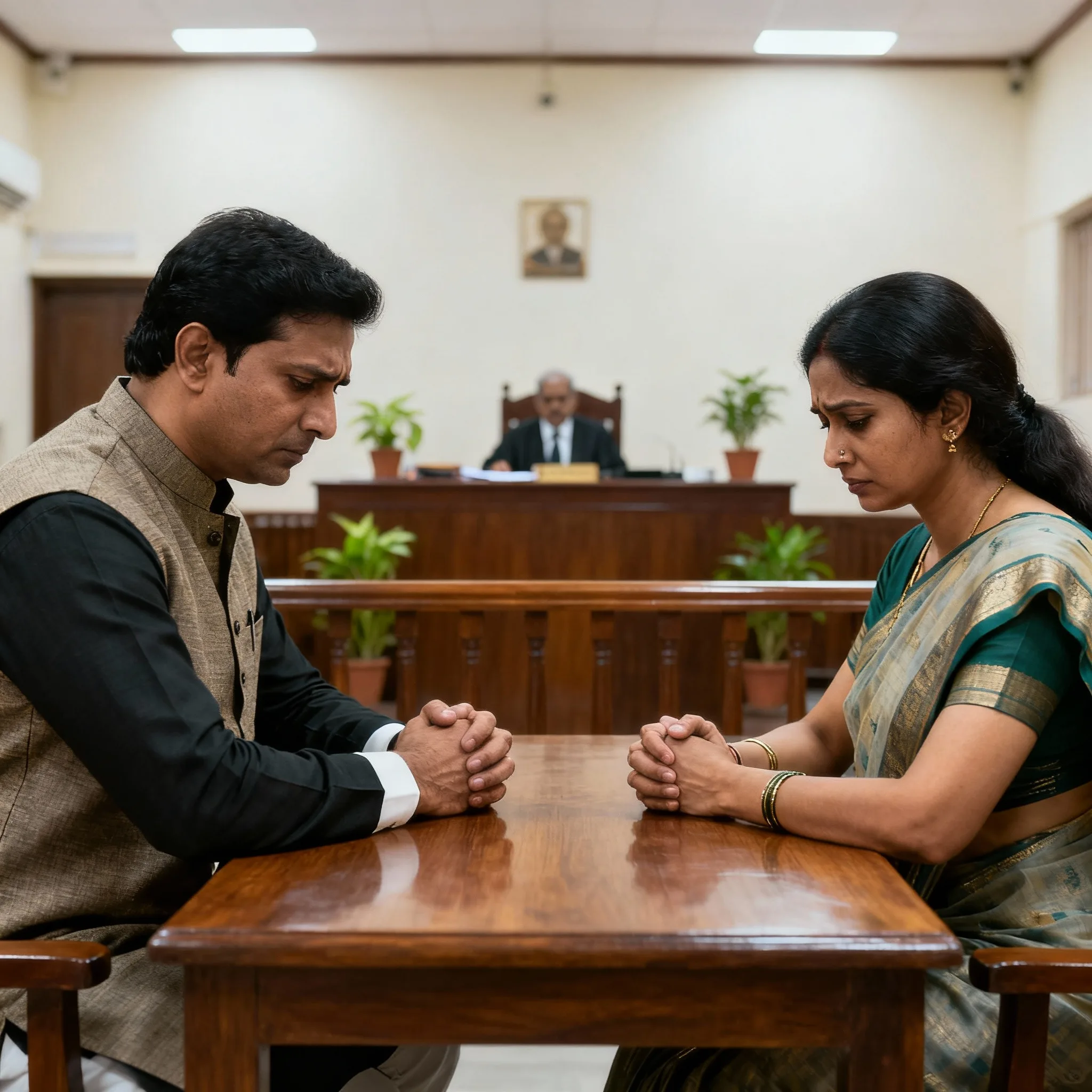
The mutual divorce process in Delhi involves two stages (motions), both filed before the Delhi Family Court.
Step 1: Drafting and Signing the Petition
A joint petition is prepared under Section 13B(1) of the Hindu Marriage Act.
It includes:
Details of the marriage (date, place, duration).
Statements of separation and incompatibility.
Mutual agreement for divorce.
Settlement terms for alimony, custody, and property.
Both parties sign this petition, typically drafted by a mutual divorce lawyer in Delhi, and file it before the appropriate Delhi Family Court (Saket, Dwarka, Rohini, Karkardooma, Tis Hazari, or Patiala House).
Step 2: First Motion Hearing
Both spouses must be present in court during the first motion.
The judge records statements, verifies consent, and may refer the couple to court-appointed mediation.
If the judge is satisfied, the first motion is approved, and the case proceeds to the next stage.
Step 3: Cooling-Off Period
After the first motion, there is a mandatory six-month cooling-off period to allow for reconciliation.
However, Delhi courts often waive this period if:
The couple has been separated for over a year.
Reconciliation attempts have failed.
All issues have been settled.
If waived, the process can conclude in 2–3 months.
Step 4: Second Motion and Final Hearing
After the cooling-off period (or its waiver), both parties appear again for the second motion under Section 13B(2).
The judge reaffirms their consent and passes the final divorce decree, legally dissolving the marriage.
Documents Required for Mutual Divorce in Delhi
You’ll need the following documents when filing for mutual divorce:
Marriage certificate
Address proof of both spouses
Passport-size photographs
Proof of separation (e.g., rent agreement, correspondence)
Proof of income and assets
Joint settlement agreement (covering alimony, custody, property)
Evidence of marriage (wedding photographs/invitations)
Having these ready speeds up the process significantly.
Cooling-Off Period and Waiver in Delhi Family Courts
The six-month waiting period is intended for reconciliation. But Delhi courts frequently grant waivers in cases where the couple has been separated for long and reconciliation is impossible.
Judicial Guidelines
As per the Supreme Court ruling in Amardeep Singh v. Harveen Kaur (2017), courts can waive the cooling-off period if:
The statutory period of separation (1 year) is already met.
Both parties have settled all issues.
Waiting would only prolong hardship.
Delhi Family Courts often allow waivers in Saket and Dwarka, enabling quicker resolution.
Role of a Mutual Divorce Lawyer in Delhi
A skilled mutual divorce lawyer in Delhi ensures that your legal rights are protected and the process remains smooth.
Key Responsibilities:
Drafting the petition and settlement agreement.
Filing paperwork accurately in the right Delhi Family Court.
Coordinating both motions efficiently.
Ensuring fair terms on alimony, custody, and property.
Representing you during hearings.
Hiring a mutual consent divorce lawyer in Delhi reduces stress, avoids procedural errors, and helps conclude the case faster.
Benefits of Hiring a Local Divorce Lawyer in Delhi
Delhi has six major Family Courts — Saket, Dwarka, Rohini, Karkardooma, Tis Hazari, and Patiala House. Each has its own filing and hearing procedures.
A local lawyer familiar with these courts ensures:
Quicker scheduling of hearings.
Proper documentation and jurisdictional filing.
Easier communication and coordination.
Moreover, local representation from Niyamam Law Offices ensures personalized, accessible support throughout the process.
Timeline and Cost of Mutual Divorce in Delhi
Timeline
Without cooling-off waiver: 6–9 months
With waiver: 2–3 months
Documentation preparation: 1–2 weeks
Cost
Fees vary based on case complexity and lawyer expertise.
Average mutual divorce lawyer fee: ₹25,000–₹75,000
Filing and documentation costs: ₹1,000–₹3,000
Niyamam Law Offices offers transparent and ethical fee structures for mutual divorce cases in Delhi.
Delhi Family Courts for Mutual Divorce Filings
| Family Court | Jurisdiction Area |
|---|---|
| Saket Family Court | South & South-East Delhi |
| Dwarka Family Court | South-West Delhi |
| Rohini Family Court | North & North-West Delhi |
| Karkardooma Family Court | East & North-East Delhi |
| Tis Hazari Family Court | Central Delhi |
| Patiala House Family Court | New Delhi District |
Filing in the correct court based on your residential jurisdiction ensures a smoother process.
Alimony, Maintenance & Child Custody in Mutual Divorce
In mutual divorces, all settlements are reached by agreement before filing.
Alimony and Maintenance
The amount is mutually decided based on:
Duration of marriage
Income disparity
Lifestyle and responsibilities
Future needs
Delhi courts generally approve the agreed amount unless it appears unfair or coerced.
Child Custody
Custody decisions prioritize the child’s welfare.
Common arrangements include:
Joint custody (shared parenting)
Physical custody with visitation rights
Courts encourage mutual parenting wherever possible.
Common Mistakes Couples Make During Mutual Divorce
Not clearly defining financial terms.
Ignoring documentation details.
Failing to agree on child custody terms.
Withdrawing consent mid-process.
Choosing the wrong jurisdiction or incomplete paperwork.
A mutual divorce lawyer in Delhi helps you avoid these costly errors.
How Niyamam Law Offices Can Help
At Niyamam Law Offices, our team of experienced mutual consent divorce lawyers in Delhi has successfully guided numerous couples through amicable separations.
We ensure:
Smooth filing across all Delhi Family Courts.
Proper documentation and representation.
Fair settlements respecting both parties’ dignity.
Confidential, empathetic, and transparent service.
Our aim is to help you move forward peacefully — legally and emotionally
Conclusion
A mutual divorce in Delhi offers a respectful, time-efficient, and amicable way to end a marriage. With the right legal guidance, couples can complete the process smoothly without unnecessary conflict.
Working with an experienced mutual divorce lawyer in Delhi like those at Niyamam Law Offices ensures that every legal detail — from filing to settlement — is handled professionally and compassionately.
Divorce marks the end of one chapter but also the beginning of another — one defined by peace, clarity, and personal growth.
Frequently asked Questions
Usually 6 months, but it can be completed in 2–3 months if the court waives the cooling-off period.
Yes, if your marriage was solemnized or last resided together in Delhi.
Yes, both must appear for the first and second motions.
The case cannot proceed — mutual consent is required until the final decree.
Typically between ₹25,000 and ₹75,000 depending on complexity and representation.